
Perimenopause and Your Skin — Why Everything Is Changing and What Actually Helps
The hormonal explanation for what you're seeing in the mirror — and the non-toxic approach that works
If your skin seems to be aging faster than you expected — suddenly drier, losing firmness in ways that feel accelerated, developing texture you didn't have before — you're not imagining it, and it's not random.
Perimenopause changes skin. Measurably, physiologically, in ways that no single topical product can fully address. Understanding why it happens is the first step to doing something genuinely effective about it.
At Aurum Sage in Vancouver, WA, skin health and hormonal health are treated as connected — because they are. This post explains the connection and what microneedling offers for women navigating this transition.

What Perimenopause Does to Your Skin
Estrogen plays a profound role in skin health that goes far beyond what most women are told. Estrogen receptors are present throughout the skin — in fibroblasts, keratinocytes, melanocytes, and sebaceous glands. Estrogen actively maintains collagen production, skin thickness, moisture retention, and wound healing capacity.
As estrogen fluctuates and eventually declines in perimenopause, several things happen to skin in fairly rapid succession:
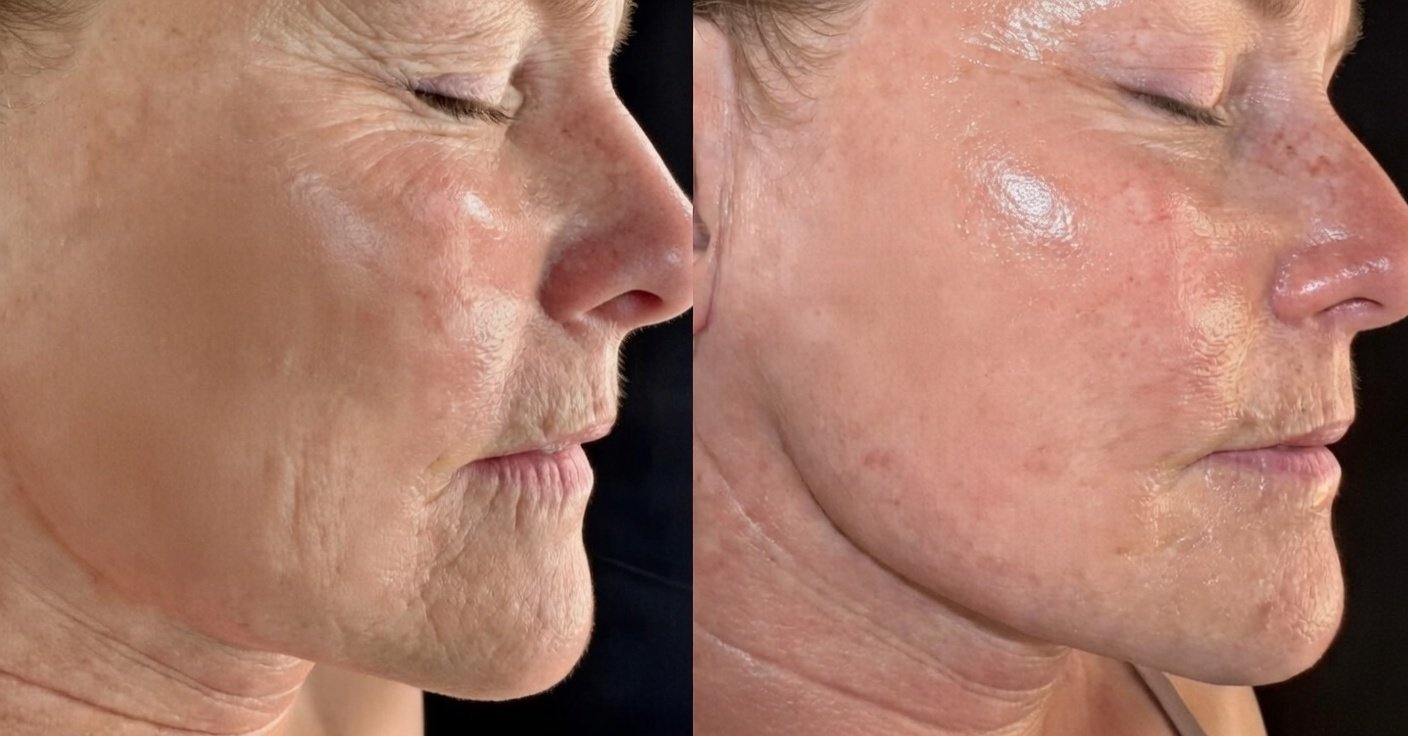
Collagen loss accelerates. Women lose approximately thirty percent of their skin's collagen in the first five years after menopause — a rate significantly faster than the gradual one-percent- per-year loss of earlier decades. The result is visible: loss of firmness, the appearance of lines that weren't there before, and a quality of translucency or thinness in the skin.
Moisture retention decreases. Estrogen supports hyaluronic acid production in the skin. As levels fall, skin becomes drier, more sensitive, and less able to maintain its barrier function.
Healing slows. Estrogen supports the skin's wound healing capacity. In perimenopause, this slowdown means that post-inflammatory marks (from breakouts, minor injuries, or sun damage) take longer to resolve.
Texture shifts. The combination of reduced cell turnover, decreased moisture, and altered sebum production changes the surface quality of skin in ways that feel unfamiliar — rougher, less even, less elastic.
Why Topicals Alone Are Insufficient
The skincare industry has a financial interest in convincing you that the right combination of topical products can address these changes. Some topicals — particularly retinoids and vitamin C — do have meaningful effects on skin quality. But they work at the surface of the dermis.
The collagen loss driving most visible perimenopausal skin changes is happening in the deeper dermis. Topical ingredients, regardless of their quality, cannot physically penetrate to this depth in concentrations sufficient to produce structural change.
This is why microneedling — which works by triggering physiological collagen production from within — is one of the most effective tools available for perimenopausal skin.

What Microneedling Offers for Perimenopausal Skin
Microneedling at Aurum Sage directly addresses the primary mechanisms driving perimenopausal skin aging:
Collagen stimulation at depth: The micro-injury response activates fibroblasts in the dermis — the same cells that estrogen was previously supporting. New collagen is produced, skin thickness increases, and firmness improves.
Accelerated cellular turnover: The healing response triggered by microneedling accelerates the skin's renewal process, improving texture and tone.
Enhanced absorption of actives: During microneedling, the botanical serums we apply — formulated specifically for hormonal skin changes — are absorbed at tissue depth rather than sitting on the surface.
Red light therapy support: The photobiomodulation component of our sessions stimulates mitochondrial function in skin cells — directly counteracting the cellular energy decline associated with hormonal aging.
A course of four to six initial sessions, followed by maintenance every three to four months, produces ongoing collagen stimulation that helps compensate for the decline in estrogen-driven production.
The Whole Picture Approach
At Aurum Sage, we understand that skin is a reflection of internal health. The most complete approach to perimenopausal skin combines external treatment — microneedling, red light, quality botanicals — with internal support through naturopathic medicine and, when appropriate, nutritional and hormonal assessment.
Dr. Chelsea offers both microneedling and naturopathic functional medicine consultations. If your skin changes are part of a broader hormonal picture you'd like to understand more fully, that conversation is available.
Ready to Experience It for Yourself?
Your skin is responding to real physiological changes. And those changes respond to real physiological treatment.
Microneedling at Aurum Sage is available in Vancouver, WA with Dr. Chelsea — a practitioner who understands the hormonal context of what you're experiencing, not just the surface of it.